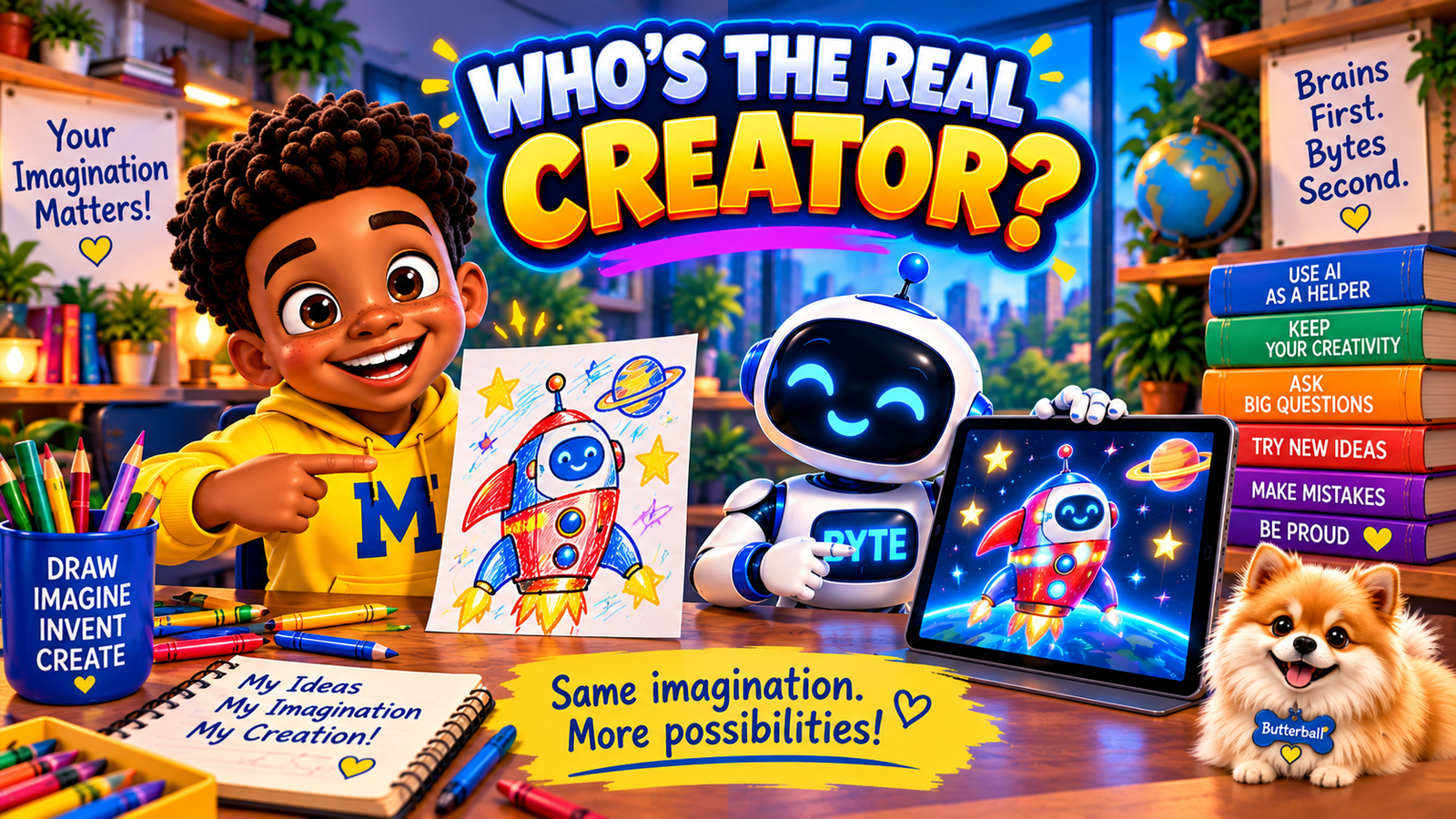
Imagine your child sitting at the kitchen table with a blank sheet of paper. You ask them to draw a magical creature.
They pause, pick up a crayon, and begin imagining. Maybe their creature has purple wings, roller skates, and a tail made of rainbows.
Now imagine giving that same child an AI image generator. Within seconds, a beautiful magical creature appears on the screen. No crayons. No messy table. No waiting.
The result might be impressive. But here's the question parents should be asking:
Did the technology help your child become more creative—or did it do the creating for them?
Creativity Is More Than Making Something Beautiful
When children draw, build, invent stories, or make up games, they're making decisions, solving problems, experimenting with possibilities, and discovering what happens when their first idea doesn't work.
A crooked drawing, unfinished story, or cardboard spaceship held together with tape can be valuable because the child imagined it and worked to bring it to life.
Creativity isn't only about the finished product. It's also about the thinking that happens along the way. AI can produce polished results quickly, but speed and polish aren't the same as imagination.
Can AI Actually Help Children Become More Creative?
Potentially, yes. AI tools can suggest ideas, introduce new possibilities, and help children explore subjects they're curious about.
Imagine your child invents a character named Captain Rainbow, who lives on a floating island and protects magical animals. With appropriate adult guidance and an age-appropriate tool, AI could help them brainstorm questions: What challenges might Captain Rainbow face? What unusual animals live on the island? What if the island suddenly lost its colors?
The child still makes the important creative decisions. The technology provides suggestions, not the entire adventure.
Research into AI's effects on creativity is still developing, especially for younger children. The goal isn't to make AI the storyteller. It's to help children become better storytellers themselves.
The Problem With Always Choosing the Easy Answer
When children encounter a difficult puzzle, they might try one solution, then another, then something unexpected. That effort offers opportunities to practice persistence and problem-solving.
If a computer instantly provides every answer, children may finish faster but miss chances to develop their own ideas. The same applies to creative activities. If AI writes the story, chooses the colors, invents the characters, and solves the problems, what decisions are left for the child?
It doesn't mean AI should never be part of a creative project. It means parents should notice who is doing the thinking.
5 Ways to Keep Your Child's Imagination in Charge
1. Start With a Blank Page, Not a Screen
Before introducing a digital tool, encourage your child to invent something independently. Ask them to draw an imaginary animal, design a new planet, or tell a story about a mysterious door. Let the first idea come from their imagination.
Try this: “If you could invent a brand-new animal, what would make it special?” There are no wrong answers.
2. Let Your Child Be the Director
If you choose to explore an age-appropriate AI tool together, let your child control the creative decisions. Instead of asking AI to invent a whole story, ask: “Who is the main character?” “What problem should they solve?” “How should the story end?”
Try this: Make a three-part story together—beginning, problem, and ending. Let your child choose all three.
3. Celebrate Imperfect Creations
AI-generated pictures can look polished. But children shouldn't feel their drawings, stories, or crafts must look professional to be worthwhile. Celebrate effort, imagination, and choices.
Try this: Instead of only saying “That's a beautiful picture,” ask “How did you come up with that idea?” or “What's your favorite part?”
4. Make Room for Boredom
Not every quiet moment needs an app, video, or instant answer. Unstructured time can create room for imagination. A cardboard box might become a spaceship, a blanket a castle, or building blocks an imaginary city.
Try this: Put paper, crayons, blocks, and safe craft materials in an invention basket. Challenge your child to invent something nobody has ever seen before.
5. Ask, “What Would YOU Do Differently?”
If you encounter an AI-generated picture or story together, ask “What would you change?” “Can you think of a more surprising ending?” or “What would make this character more interesting?”
These questions turn children from passive viewers into active thinkers. The goal isn't simply to accept what technology creates—it's to evaluate, question, and imagine something new.
A Family Creativity Challenge: The Impossible Invention
- Invent it: Imagine a machine that solves a silly problem, like a robot that folds rainbows.
- Draw it: Sketch the invention on paper.
- Explain it: What does it do, and how does it work?
- Improve it: Add one surprising feature.
- Celebrate: Give the invention a name and display it.
No AI tool is required. The most important technology in this activity is your child's imagination.
So, Is AI Making Kids Less Creative?
There's no simple yes-or-no answer. AI can offer inspiration and help people explore ideas. But relying on it to do every creative task could reduce opportunities for children to practice imagining, experimenting, and solving problems independently.
We don't yet have enough long-term evidence to say exactly how AI will affect the creativity of children ages 5–9. Parents can encourage children to create before asking technology for suggestions, give them room to make mistakes, and celebrate original ideas—even when they're messy.
Young children don't need direct access to AI tools to learn about AI. They can explore these concepts through stories, games, discussions, and parent-guided activities.
Brains First. Bytes Second.
At Marcus & Byte Studios, we believe artificial intelligence should expand children's curiosity, not replace their imagination. Through animated adventures, creative challenges, and family activities, Marcus and his friendly robot companion Byte encourage children to ask questions, explore possibilities, and trust their own thinking.
The future doesn't just need children who know how to use AI. It needs children who can imagine things AI has never seen before.
Keep Exploring With Marcus & Byte
Discover educational adventures, free family activities, and more parent resources.
Watch on YouTubeFree ActivitiesMore Parent ArticlesBrains First. Bytes Second.
A Brighter World Starts With You.
A Question for Parents
What activities bring out your child's most creative ideas? Start a family conversation about what makes their imagination special.