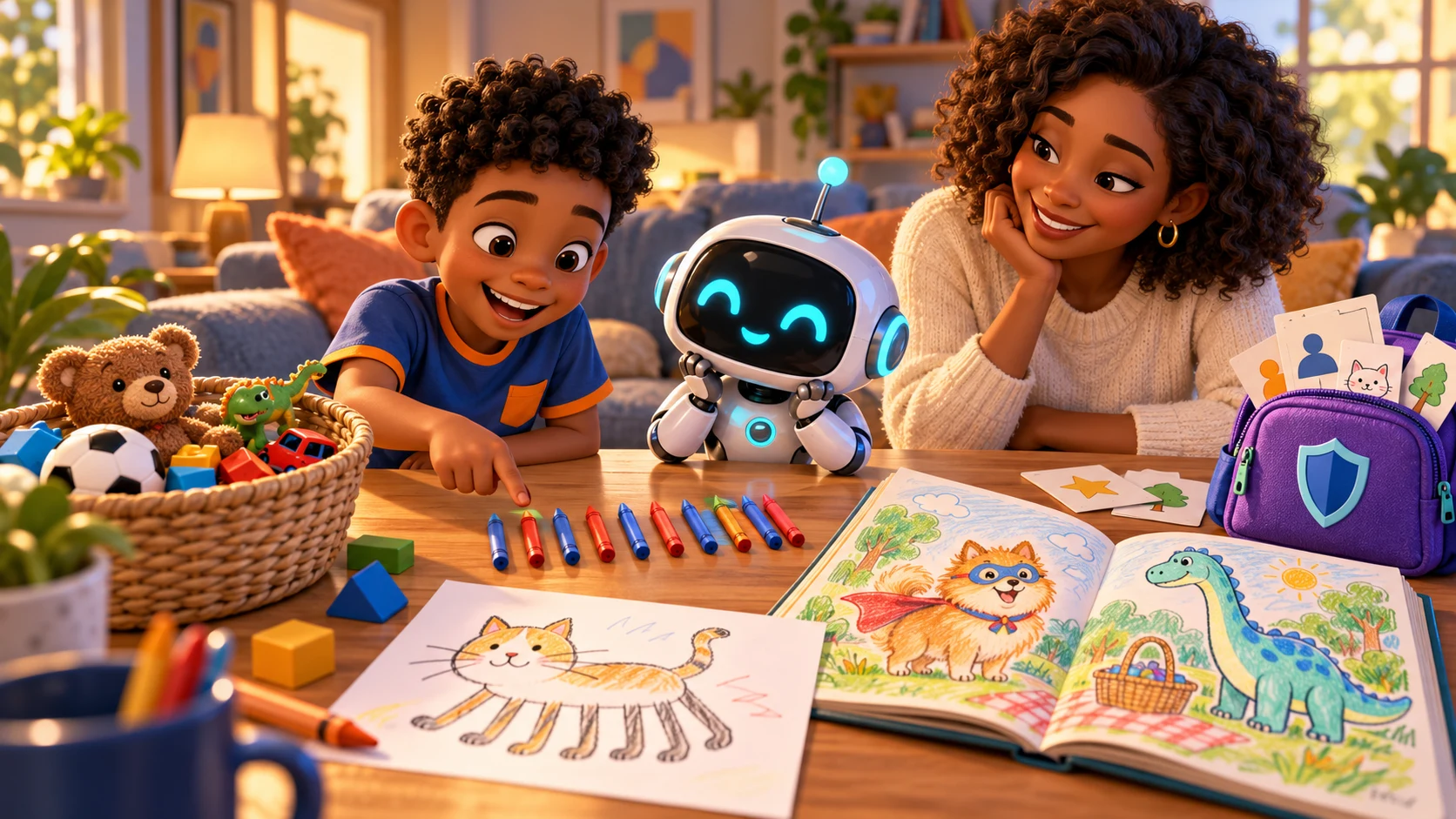
By Vanessa R. James | Marcus & Byte Studios
Your child asks, “What is AI?” You pause. Do you need to explain computers, coding, or how a chatbot works?
You can start with something much simpler: a game you play together.
For children ages 5–9, everyday activities offer a way to explore the ideas behind artificial intelligence. You can practice noticing patterns, giving clear instructions, and checking answers using things already in your home.
A simple explanation to begin with is: “AI is computer technology that uses patterns in information to make predictions or create things. It can help us, but it can also get things wrong.”
Then try one of these five activities. No AI account or screen required.
1. Play “Teach the Robot”
You need: A few toys or household objects.
Pretend you are a robot that needs instructions. Ask your child to tell you how to put a toy in a basket. Follow their words literally, while keeping the game safe and silly.
If they say, “Put it over there,” ask, “Which object? Where should it go?” Let them try again with more detail.
Ask together: “What made your instructions easier to follow?”
The AI connection: Clear instructions can help an AI tool produce a more useful response. This game explores that idea; real AI does not always follow instructions exactly, so we still check its work.
2. Become Pattern Detectives
You need: Socks, blocks, buttons, or crayons.
Make a simple pattern: blue crayon, red crayon, blue crayon, red crayon. Ask your child what might come next.
Next, sort objects by a shared feature, such as color or size. Try sorting them a different way. A red sock and a red block can belong together by color, even though they are different objects.
Ask together: “What clues did you use? Could another pattern give us a different answer?”
The AI connection: Many AI systems find patterns in examples. A pattern can help with a prediction, but it does not guarantee the prediction is correct.
3. Catch Byte’s Silly Mistake
You need: Paper and a pencil—or just your voices.
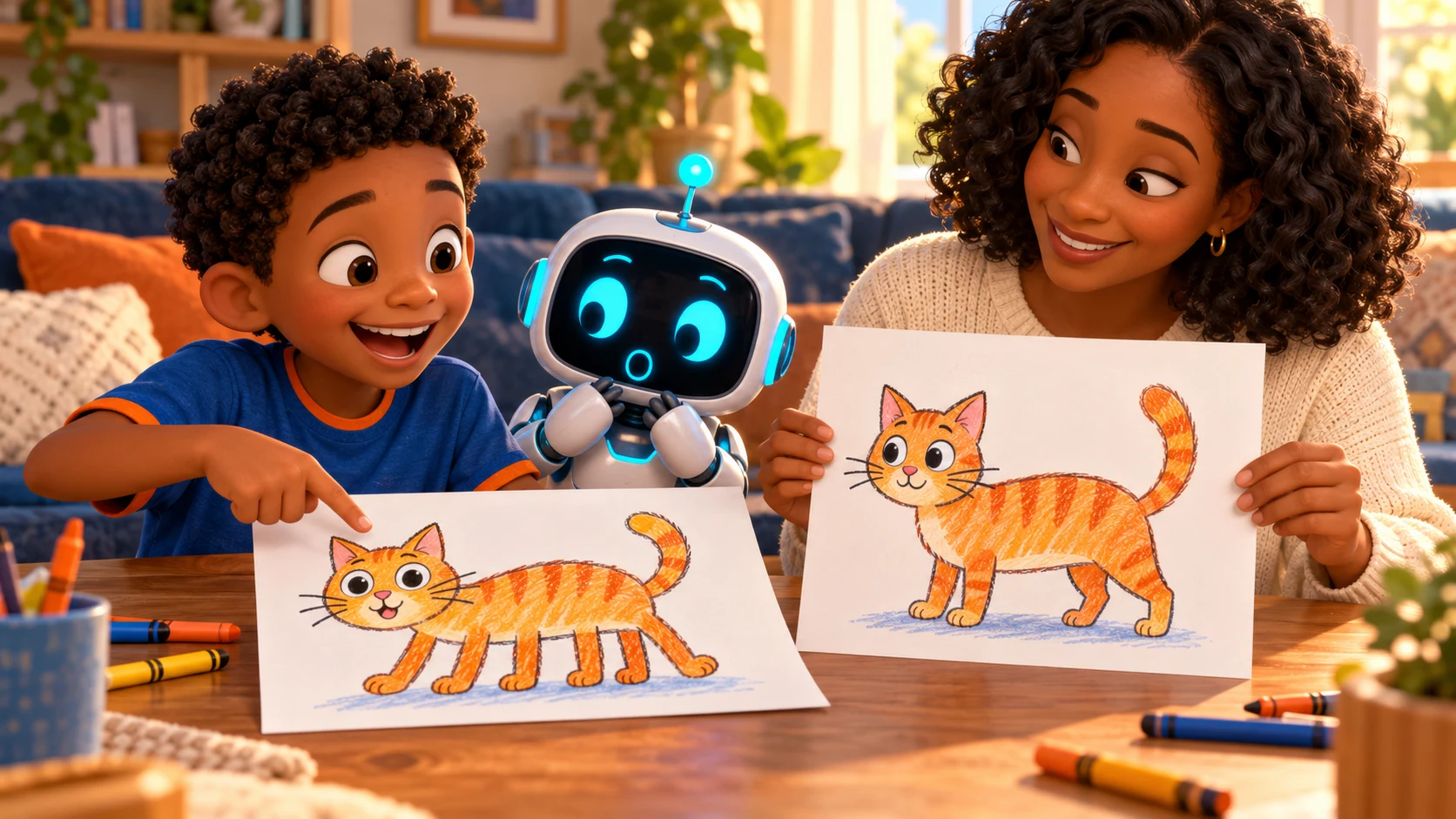
Pretend Byte has mixed up some everyday facts. Say, “A bicycle usually has three wheels,” or draw a cat with six legs.
Invite your child to investigate. Can they compare the claim with a bicycle outside, a picture in a book, or something they already know? Let your child invent the next mistake for you to catch.
Ask together: “How could we check this if we weren’t sure?”
The AI connection: An AI answer can sound convincing and still be wrong. Checking is a useful skill, even when the answer looks polished.
4. Make a Story With a Helpful Sidekick
You need: Paper and crayons.
Ask your child to invent a hero, a problem, and a setting. Perhaps Captain Butterball needs to find a missing picnic basket in a dinosaur park.
You play the helpful sidekick and offer three possible next steps. Your child chooses one, changes it, or invents something better. Draw the ending together.
Ask together: “Which idea fits your story? What would you change?”
The AI connection: AI can offer suggestions. Your child can practice deciding which ideas to use while keeping their own imagination in charge.
5. Pack a Pretend Privacy Backpack
You need: Paper cards and a bag or basket.
Write imaginary examples on cards: “a made-up dragon name,” “a favorite color,” “a home address,” “a password,” and “a school name.” Use pretend details rather than your family’s actual information.
Explain that information typed into an online tool is being shared with that service. Together, decide which cards contain private details that should stay out of an AI chat. Put those in the privacy backpack.
Ask together: “Could this tell someone who we are or where to find us?”
The AI connection: Learning about AI includes learning to protect personal information. If you later explore an actual tool, an adult should choose it, check its age requirements, and guide the activity.
Start With One Small Adventure
You don’t have to teach all five activities at once. Pick one, spend ten minutes playing, and follow your child’s questions.
The goal is to help your child stay curious, explain their thinking, and recognize when an answer needs another look. You can learn beside them.
At Marcus & Byte Studios, we explore AI through stories and activities that parents and children can enjoy together. For your first family challenge, ask: “If Byte made one silly mistake today, how would you help him check it?”
Brains First. Bytes Second.
Keep Exploring Together
Get the free parent guide for more ways to help your child explore AI with curiosity and care.
Get the Free Parent Guide →